
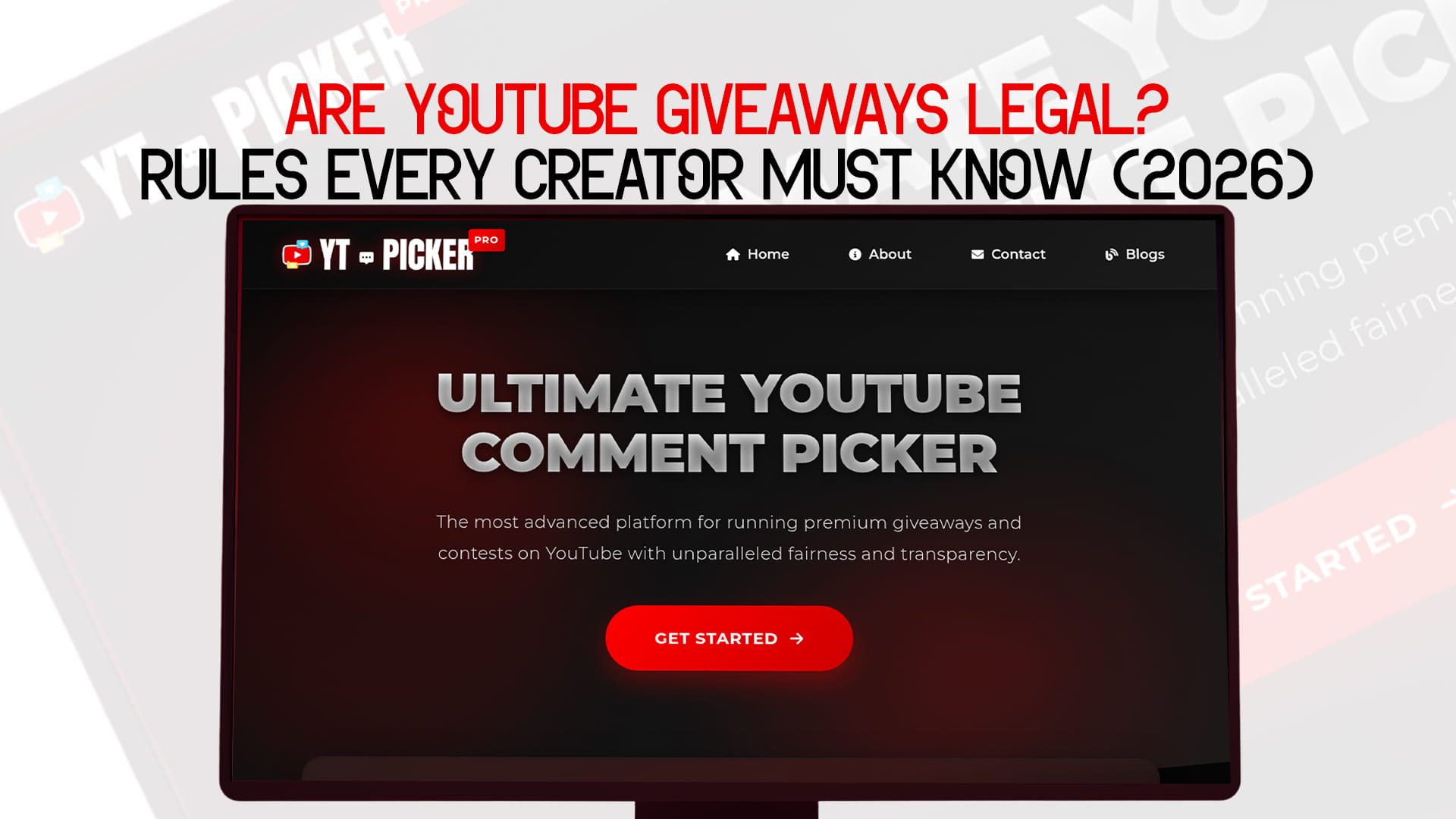
Are YouTube Giveaways Legal? Rules Every Creator Must Know (2026)
Yes, YouTube giveaways are legal. Creators run them every day to grow channels, reward subscribers, and spike engagement during launches. The catch is that "legal" answers to two separate rulebooks, and most creators only read one of them.
The first rulebook is the law where your participants live: FTC consumer protection rules and state promotion laws in the US, plus equivalents abroad. The second is YouTube's own contest policy, which is part of its Terms of Service. You can follow YouTube's rules perfectly and still break the law. You can be fully legal under the law and still get your video pulled for a YouTube policy violation. You need both.
This guide walks through both rulebooks for 2026, the disclosures your giveaway must include, the mistakes that get channels penalized, and how to pick winners in a way you can defend if anyone questions it.
Quick answer: A YouTube giveaway is legal when entry is free (no purchase required), your official rules and disclosures are clear and easy to find, you don't manipulate YouTube metrics like subscribers or likes, you state that YouTube doesn't sponsor or endorse the contest, and you pick the winner by a fair, documented method. Large prizes can also trigger state registration. None of this is legal advice; check the law where your participants live.
This isn't legal advice, and I'm not your lawyer. For a high-value prize or a cross-border campaign, run your rules past an attorney before you hit publish.
Sweepstakes, contest, or lottery: why the difference decides everything
Before anything else, you need to know which of these three you're actually running, because the law treats them very differently.
A lottery has three ingredients: a prize, winners chosen by chance, and consideration (something of value that participants give up to enter, usually money). When all three are present, it's a lottery, and in the US only the government can legally run one. That's the trap you have to design your way out of.
Most YouTube "giveaways" are sweepstakes. Viewers comment to enter, and you draw a random winner. That's chance, so you have to drop the consideration: no purchase, no payment, no fee. A contest is different. There, winners are judged on skill (best edit, best recipe, funniest reply), so you can sometimes charge to enter, though several states restrict entry fees even for skill contests. When people say "giveaway," they almost always mean a no-purchase sweepstakes, so the rest of this guide focuses there.
The federal rules: FTC and "no purchase necessary"
In the US, the Federal Trade Commission enforces truth-in-advertising and consumer protection law, and that reaches promotions like yours. The FTC Act prohibits unfair and deceptive practices, which is why misleading or hidden giveaway terms are a legal problem, not just a trust problem.
A few federal principles matter for every creator.
No purchase necessary. For a sweepstakes, entry has to be free. This is the line that keeps your giveaway from being classified as an illegal lottery, and "no purchase necessary" should appear clearly in your rules.
Consideration isn't only about money. Consideration can also mean significant time or effort. An entry process that's deliberately long or convoluted can count, even if no one pays a cent. Keep entering simple.
Offer an alternate method of entry (AMOE) if any paid path exists. If your promotion has any purchase-linked entry route, you must also give a free way in with equal odds of winning. Lawyers call this "equal dignity." For a standard comment-to-enter YouTube giveaway, you usually don't need a separate AMOE, because entry is already free for everyone.
Disclose the material terms clearly and conspicuously. Who can enter, how to enter, the deadline, the prize and its value, the odds, and how the winner is picked all have to be stated up front and easy to find, not buried.
State laws that catch people off guard
Federal rules are only half the US picture. A handful of states add registration and bonding requirements once your prize gets big enough, and creators with a sizable budget run straight into them.
Florida and New York both require you to register the promotion and post a surety bond when the total value of all prizes is more than $5,000. In Florida, you register with the Department of Agriculture and Consumer Services, file before the promotion starts, and submit a winners list afterward. New York works similarly, with filing typically required around 30 days before launch.
Rhode Island is narrower. It requires registration (no bond) for sweepstakes run through a retail location with prizes over $500. That mostly affects in-store promotions rather than a pure online giveaway, but it's worth knowing if you have a brick-and-mortar tie-in.
Two practical ways creators stay under the line: keep total prize value under $5,000, or exclude residents of those states from entering. Either approach is common, and both should be stated plainly in your rules.
YouTube's contest policy: the platform rulebook
Now the second rulebook. Even a perfectly legal giveaway can get your video removed or your channel struck if it breaks YouTube's contest policy. Here's what that policy actually requires.
Don't manipulate engagement metrics. This is the big one, and it's the rule creators break most often. YouTube's policy says you and any third party may not manipulate metrics to misrepresent genuine engagement. That covers views, likes, dislikes, and subscribers. This is YouTube's Fake Engagement Policy, and it's why "smash subscribe and like 10 of my videos to enter" is risky when those actions exist only to inflate your numbers.
Don't imply YouTube is involved. You can't associate or affiliate YouTube with your contest without its prior written consent. In plain terms, you must state that YouTube does not sponsor, endorse, or administer your giveaway. A simple line works: "This giveaway is not sponsored, endorsed, or administered by YouTube."
Publish official rules that meet YouTube's conditions. Your rules need to link to the YouTube Community Guidelines and say that entries that don't comply will be disqualified, state every disclosure required by applicable laws, and stay consistent with YouTube's Terms of Service.
Stay lawful and respect others' rights. Your contest has to comply with all applicable laws in the places it's offered, and it can't use copyrighted music, footage, or other material you don't have the rights to.
Keep the giveaway inside your content. As a rule of thumb, run it in a normal video, a dedicated upload, or a livestream rather than through paid YouTube ads.
What "subscribe to enter" actually means under the rules
This is the question I get most, so let's be precise about it.
You're allowed to ask people to subscribe, like, or comment. Encouraging genuine engagement is fine. What you can't do is build your entry mechanism so that it exists mainly to pump your metrics, or make a tracked subscribe-or-like the only thing standing between someone and the prize. YouTube's fake engagement rule is aimed at artificial inflation, not at normal community interaction.
The clean, low-risk pattern most creators land on: ask for a real comment as the entry action ("comment your favorite moment from this video to enter"). Treat subscribing and liking as optional and encouraged, not as the tracked condition for winning. That keeps you on the right side of the policy while still growing the channel through people who actually want to be there. A burst of followers who showed up only for free stuff rarely sticks around anyway.
Your official rules and disclosures: the checklist
Whether you host rules on a dedicated page or in a pinned comment and description, they should cover all of the following. Keep them in one fixed location so the link doesn't change mid-campaign.
- Eligibility: minimum age and which countries or states can enter (and which can't).
- Entry period: exact start and end dates and times, including time zone.
- How to enter: the precise action, stated simply.
- No purchase necessary: a clear statement that entry is free.
- Prize details: an accurate description and the prize's value.
- Odds and winner selection: roughly how many entries you expect and how the winner is drawn.
- Notification: how and when you'll contact the winner, and what happens if they don't respond.
- The YouTube disclaimer: that YouTube does not sponsor, endorse, or administer the giveaway.
- Community Guidelines link: plus a note that non-complying entries are disqualified.
- Sponsor and "void where prohibited": who's running it, and the standard legal catch-all.
One more disclosure people forget: if a brand is paying you to run the giveaway or supplying the prize, that's a material connection, and FTC guidance expects you to disclose the relationship clearly in the video itself, not only in fine print.
Picking winners fairly is part of staying compliant
Here's the piece creators treat as an afterthought and shouldn't: how you choose the winner is a compliance issue, not just an etiquette one. Your rules promise a fair selection. If you can't show that the draw was genuinely random and unbiased, you've arguably broken your own official rules, and you've definitely broken your audience's trust the moment someone notices the winner is your cousin.
Manual selection is the weak point. Scrolling and stopping on a comment looks arbitrary, can't be verified, and invites accusations of favoritism. A dedicated picker fixes that by giving every eligible entry an equal chance and producing a result you can show on screen.
This is the gap YT Picker is built to close. It's the most advanced platform for running premium giveaways and contests on YouTube with unparalleled fairness and transparency, pulling the comments from your video and drawing a winner with verifiable randomness rather than a guess. Because the draw is documented and repeatable, you can record it, share it, and answer "how did you pick?" with an actual answer.
A few habits make the whole thing defensible:
- Use a random comment picker so selection is mechanical and equal, not subjective.
- Decide your filters before you draw (replies included or not, duplicate comments removed) and state them, so the process matches the rules you published. A guide to running a transparent giveaway end to end walks through this.
- Record your screen during the draw for proof, then announce the winner publicly.
If you're testing the waters on a small channel, you can run the same fair process with a free YouTube comment picker, and pick a winner without creating an account when you just need a quick, clean result.
Common mistakes that get channels penalized
Most giveaway trouble comes from process gaps, not bad intent. These are the ones that bite:
- Requiring purchases or payment. That turns a sweepstakes into an illegal lottery in the US.
- Making subscribe or like the tracked, sole way to enter. This runs into YouTube's fake engagement rule.
- Skipping the YouTube disclaimer. Implying YouTube is involved violates the policy outright.
- No published rules. Without clear terms, you're exposed legally and on the platform.
- Ignoring age and location limits. Some prizes are illegal for minors, and some regions regulate promotions heavily.
- Forgetting state registration on big prizes. Over $5,000 can mean filing and bonding in Florida or New York.
- Using copyrighted music or footage. Rights issues can take the video down on their own.
- Picking the winner manually. It looks biased, can't be verified, and can contradict your own rules.
A 10-minute pre-launch compliance check
Run through this before you publish. If any item is missing, fix it first.
- Entry is free, with "no purchase necessary" stated.
- Official rules are written and live at a fixed link.
- Eligibility (age, location) is defined, with excluded states or countries listed.
- The entry action is genuine engagement, not a metrics-inflation scheme.
- The "YouTube does not sponsor or endorse" disclaimer is included.
- Rules link to the Community Guidelines and note disqualification for non-compliance.
- Prize value is below state thresholds, or you've handled registration.
- Any brand sponsorship is disclosed in the video.
- No copyrighted material is used without rights.
- Your winner-selection method is fair, documented, and ready to show.
What about giveaways outside the US?
The structure of the rules travels even when the specifics don't. Most countries draw the same line between a prohibited lottery and a permitted sweepstakes or skill contest, and most expect clear terms, eligibility limits, and honest winner selection. What varies is the detail: some countries restrict random-chance prize draws more tightly, some require local registration or a notary for the draw, and rules can differ across regions within a single country. If your audience is global, the safe move is to set eligibility based on where you've actually checked the law, and exclude regions you haven't.
Are YouTube giveaways legal in 2026? Yes. They're legal when entry is free, your rules and disclosures are clear, you don't manipulate YouTube metrics, you state that YouTube isn't a sponsor, and you pick winners fairly. Large prizes can also trigger state registration in the US.
Do I need a "no purchase necessary" statement? For a sweepstakes (random winner), yes. Requiring a purchase to enter a chance-based giveaway can make it an illegal lottery in the US, so free entry and a clear "no purchase necessary" line are essential.
Can I make people subscribe to enter? You can ask, but you shouldn't make a tracked subscribe or like the only entry condition, because that runs into YouTube's Fake Engagement Policy. Use a genuine comment as the entry action and treat subscribing as optional.
What's the difference between a sweepstakes and a contest? A sweepstakes picks winners by chance and must be free to enter. A contest picks winners by skill judged on set criteria and can sometimes charge an entry fee. Most YouTube giveaways are no-purchase sweepstakes.
Do I have to register my YouTube giveaway? Usually not for small prizes. In the US, Florida and New York require registration and a bond when total prize value tops $5,000, and Rhode Island requires registration for retail promotions over $500. You can stay under the threshold or exclude those states.
Do I really need to say YouTube isn't involved? Yes. YouTube's contest policy bars you from implying it sponsors or endorses your giveaway without written consent. A short disclaimer that it isn't sponsored, endorsed, or administered by YouTube covers it.
Why can't I just pick a winner myself? Manual picking looks biased, can't be verified, and can contradict the fair-selection promise in your own rules. A random comment picker gives every entry an equal chance and produces a result you can show on screen.
What happens if I break the rules? Depending on what went wrong, you risk having the video removed, getting a channel strike or worse from YouTube, or facing legal exposure under FTC and state law for a deceptive or illegal promotion.